
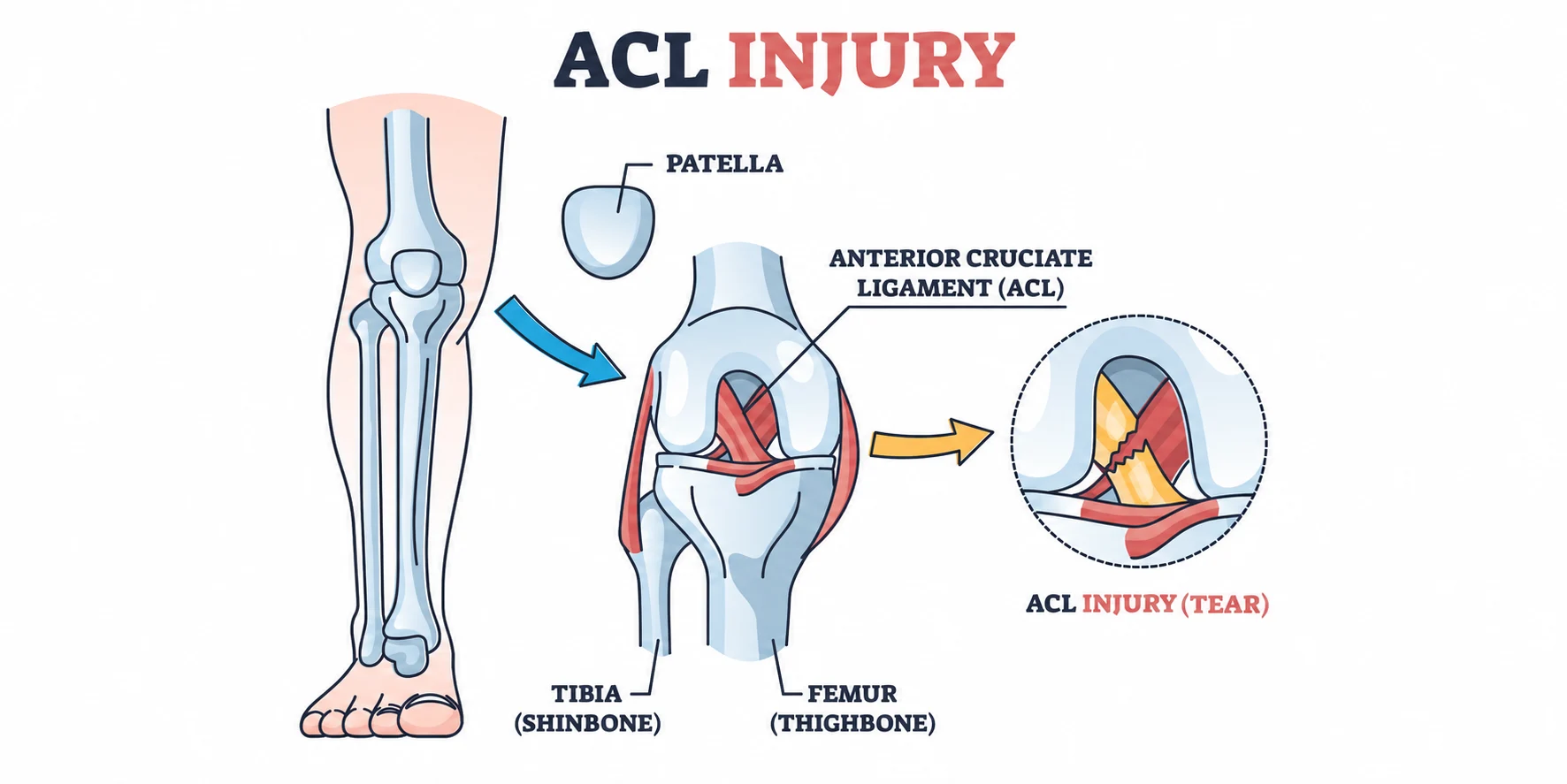
Knee braces associated with anterior cruciate ligament (ACL) recovery fall into three main functional groups: immobilizers, postoperative range-of-motion braces, and functional ligament braces. Compression sleeves are also commonly discussed, but they provide a different kind of support.
These products are not interchangeable, and patients do not necessarily progress through every type. The appropriate brace—if one is needed—depends on the injury, treatment plan, associated procedures and clinician’s assessment.
For distributors, medical supply businesses and sports brands, understanding these distinctions helps build clearer product ranges and more accurate descriptions.
ACL Knee Brace Types at a Glance
The most useful starting point is the function of the device. Terms such as “hinged,” “rigid” and “custom” describe construction or fitting rather than a separate recovery stage.
| Product category | Typical construction | Main purpose | Important distinction |
|---|---|---|---|
| Knee immobilizer | Long padded panels, rigid stays and straps | Hold the knee in a prescribed position when immobilization is required | Usually does not provide an adjustable movement arc |
| Postoperative ROM brace | Side uprights, adjustable hinges, straps and padding | Control permitted bending and straightening | Settings follow the treating clinician’s instructions |
| Functional ligament brace | Hinged frame or supportive soft construction with straps | Provide support during permitted movement | Intended use and degree of support vary by model |
| Compression sleeve | Elastic knitted or neoprene-based body | Provide compression and a close-fitting covering | Does not replace a prescribed ligament brace |
Clinical descriptions distinguish functional and rehabilitative braces from sleeves, which lack comparable structural support. See the review of knee-bracing categories and mechanisms.<!– IMAGE 1: Insert after “ACL Knee Brace Types at a Glance” | Visual: An original diagram comparing a long knee immobilizer, postoperative ROM brace, functional ligament brace and plain compression sleeve; label stays, hinges, straps and fabric body | Alt: “Structural differences between knee immobilizers, postoperative ROM braces, functional braces and compression sleeves” | Source: original diagram –>
Knee Immobilizers
A knee immobilizer uses rigid supports within a padded body to restrict movement. Straps secure the device around the thigh and lower leg. Some designs use adjustable side panels to accommodate different leg dimensions.
For example, the ProCare 3-Panel Knee Splint combines adjustable panels, supporting stays and closures for postoperative support and immobilization.
The defining feature is its immobilizing function. A basic immobilizer does not offer the same adjustable bending and straightening controls as a postoperative ROM brace.
For product comparison, examine:
- Overall length and stated fitting range.
- Position and construction of the rigid stays.
- Padding coverage and edge finishing.
- Strap placement and closure security.
- Instructions for fitting and adjustment.
Immobilization should follow the treatment plan. A patient should not independently substitute an immobilizer for a brace intended to permit controlled movement.
Postoperative Range-of-Motion Braces
A postoperative range-of-motion, or ROM, brace is designed to control how far the knee can bend and straighten.
These braces commonly combine side uprights, hinges, straps and padding. Depending on the model, the hinge system may allow locking or movement within selected limits. The components work together; the hinge alone does not determine the device’s performance.
Rehabilitative bracing can provide immobilization or movement within a prescribed arc. Hinge alignment, supporting shells and strap configuration all influence the mechanical behavior of the brace. Knee-bracing classification review.
What distinguishes a postoperative ROM brace?
Its central function is adjustable movement control. This makes it different from a plain sleeve and from an immobilizer without adjustable hinges.
When comparing models, review:
| Component | Product information to examine |
|---|---|
| Hinge | Available movement settings, locking function and adjustment instructions |
| Uprights | Length options and any permitted length adjustment |
| Straps | Placement, fastening method and adjustment range |
| Padding | Coverage, attachment and cleaning instructions |
| Fitting system | Measurement method, orientation and positioning guidance |
Postoperative products may also include features intended to help maintain position. For instance, the DonJoy X-Act ROM Knee uses a suspension frame and foam designed to reduce migration.
Patients should not change hinge settings or stop wearing a prescribed brace without instructions from their care team. MedlinePlus’s ACL reconstruction discharge guidance emphasizes following the surgeon’s directions for brace use and recovery.<!– IMAGE 2: Insert after “What distinguishes a postoperative ROM brace?” | Visual: An original close-up diagram labeling the hinge, movement stops, locking mechanism, uprights, straps and padding; do not show suggested patient settings or a recovery timetable | Alt: “Components of a postoperative knee brace with adjustable range-of-motion hinges” | Source: original diagram –>
Functional Ligament Braces
A functional knee brace is intended to support the knee during movement. In ACL care, it may be considered for selected patients or activities according to the treating professional’s assessment.
Functional braces commonly use hinges, straps and cuffs or shells to interact with the leg. Their construction differs from a simple compression sleeve. Clinical review of functional knee braces.
There are two useful construction distinctions within this group.
Rigid-frame functional braces
These use a defined frame around the thigh and lower leg, connected by hinges and secured with straps. Frame material, shape and strap configuration vary by model.
The DonJoy Defiance, for example, is a custom-fabricated functional brace with a carbon-composite frame and different ligament-instability strap configurations.
This illustrates why “ACL brace” should not be treated as a complete specification. Buyers also need the model’s intended use, fitting method, configuration and instructions.
Soft or semi-rigid hinged braces
These combine a fabric or flexible body with hinges and straps. Some models have specific ligament-support indications, but a soft hinged brace should not automatically be described as suitable for every ACL injury.
The DonJoy Playmaker/Playmaker II instructions, for example, distinguish mild ligament instability indications from more severe instability. That distinction belongs to the specified product and should not be generalized to all hinged supports.
For sourcing, evaluate the exact model rather than relying on appearance or a broad “maximum support” label.
Custom and Off-the-Shelf Braces
Custom fabrication and off-the-shelf sizing describe how a brace is fitted, not what clinical function it performs.
An off-the-shelf product is selected from an established size range. A custom-fabricated product is made using an individual fitting process. Both still need appropriate positioning and instructions.
For functional braces, custom and presized options are recognized fitting approaches. Knee-bracing classification review.
For B2B purchasing, clarify whether “custom” means:
- Patient-specific fabrication.
- A modified size range.
- Changes to materials or components.
- Private label colors, logos or packaging.
These are different services. Private label customization alone does not make a brace patient-specific.
Where Do Compression Sleeves Fit?
Compression sleeves are flexible supports made from elastic materials. They are commonly grouped with knee braces in retail catalogs, although their construction and function differ from structured braces.
A plain sleeve does not provide the adjustable movement limits of a postoperative ROM brace. It should not be presented as an equivalent replacement for a prescribed ACL support. Cleveland Clinic’s overview of knee braces and sleeves explains the distinction.
For a product range, keep sleeve descriptions focused on their actual construction and intended use. Adding the words “ACL recovery” to a generic sleeve listing does not establish suitability for that purpose.
Does Everyone Need a Brace After ACL Reconstruction?
No. Brace use is not a universal requirement throughout ACL recovery.
The American Academy of Orthopaedic Surgeons advises against routine functional bracing after isolated primary ACL reconstruction, because the available evidence does not demonstrate clinical benefit. The guideline grades this as a limited-strength recommendation and discusses limitations in the evidence. AAOS ACL injury clinical practice guideline.
This recommendation concerns routine functional bracing in a defined patient group. It should not be used to override individual postoperative instructions or to assume that combined ligament injuries and associated procedures require identical care.
For product descriptions, avoid promises that a brace will accelerate healing, prevent reinjury or make someone ready to return to sport. Describe the device’s intended function and leave treatment progression to the clinical team.
How to Compare ACL-Related Knee Brace Products
For importers, distributors and private label brands, the purchasing specification should make the product’s role clear before discussing branding.
Use the following questions when reviewing a model:
- What is its intended function? Immobilization, movement control and support during activity are different requirements.
- What does the hinge actually do? Identify movement limits, locking features and permitted adjustments.
- How is the brace fitted? Request the measurement method, size range and positioning instructions.
- Which indications and limitations apply? Match product descriptions to the model’s instructions.
- How are components maintained? Review cleaning guidance and the availability of replacement pads or straps.
- What defines an acceptable production sample? Agree on dimensions, construction, fastening performance and relevant functional checks.
Also keep clinical settings separate from factory specifications. A manufacturer can describe the available hinge settings; the patient’s clinician determines which settings to use.<!– IMAGE 3: Insert after “How to Compare ACL-Related Knee Brace Products” | Visual: A product evaluation scene showing a brace, measurement guide, hinge detail, removable padding and written specification, without depicting clinical testing | Alt: “Knee brace product review covering sizing, hinges, padding and specifications” | Source: company photo –>
Planning a Clear Knee Brace Range
A useful range distinguishes products by function rather than presenting every support as an ACL rehabilitation device. Keep immobilizers, postoperative ROM braces, functional ligament braces and compression sleeves clearly identified in catalogs and product pages.
Braces for Sports works with sports brands, medical distributors, importers and private label businesses on sports supports and medical braces. Our OEM/ODM capabilities include sampling, design revisions, material adjustments, size customization, logos and packaging.
For an ACL-related project, begin with the required clinical function and product specifications so the discussion can focus on suitable constructions and development requirements.
Contact Braces for Sports with your intended knee brace category, target market, fitting requirements and customization brief to discuss product options and samples.