
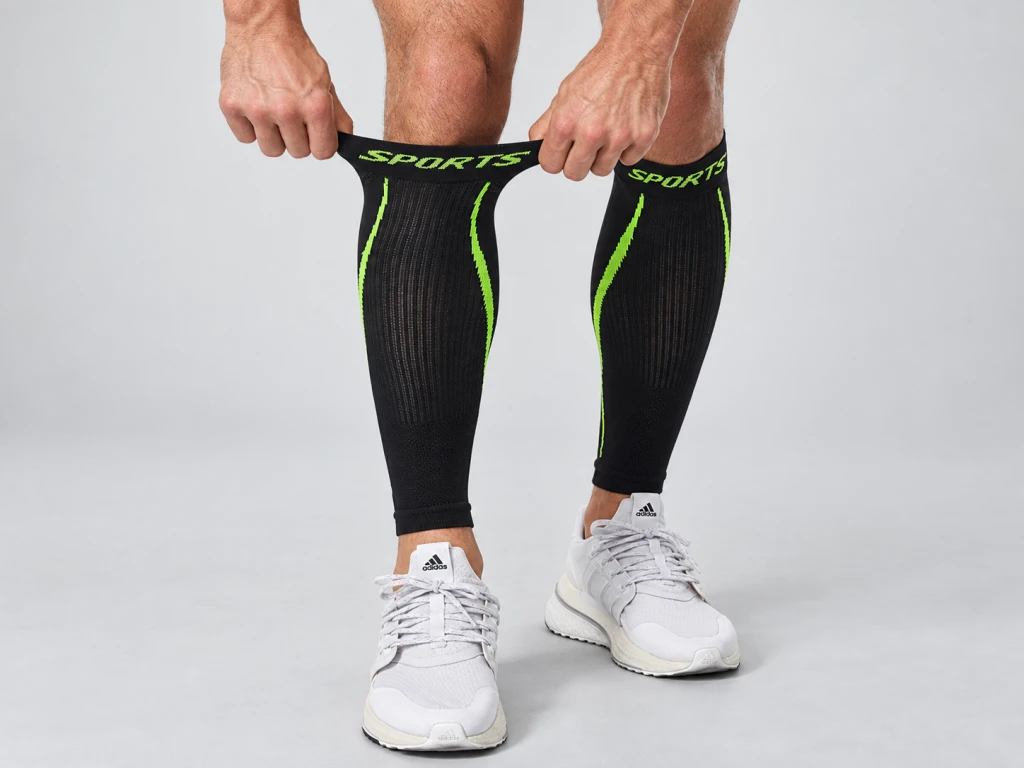
Nylon, polyester, and cotton blends are useful starting points when developing calf compression socks. Nylon-based blends suit smooth, close-fitting designs; engineered polyester blends deserve consideration when moisture management is central to the brief; cotton blends offer a familiar feel for everyday collections. Merino wool and regenerated cellulose blends provide additional options for more specialized ranges.
The right choice depends on the finished sock, including its construction, fit, care requirements, and intended use. For brands, distributors, and private-label buyers, material selection should lead to a sample comparison—not an assumption that one fiber is best for every customer.
What Are You Comparing: Fibers or Finished Socks?
Here, calf compression socks means socks that cover the foot and extend over the calf. Footless calf sleeves are a separate product format. Their materials may overlap, but a sock also needs appropriate heel fit, toe construction, and compatibility with footwear.
Most compression socks combine fibers with different roles. The base yarn contributes to the fabric’s feel and moisture behavior, while elastane—also called spandex—provides stretch and recovery. LYCRA® is a branded elastane fiber, rather than a separate generic material category. The LYCRA Company
A fiber-content label alone does not establish compression performance. Research on compression stockings shows that yarn characteristics, fabric structure, and stretching conditions affect the pressure produced. Two socks with similar compositions can therefore perform differently. Research on stocking structure and compression
Calf Compression Sock Materials Compared
Use the following comparison to shortlist sample constructions. These are development directions, rather than performance ratings for every fabric containing the named fiber.
| Material blend | Why consider it? | Main trade-off to assess | What to compare in samples |
|---|---|---|---|
| Nylon + elastane | A starting point for smooth, closely fitted hosiery | Comfort and ease of pulling on depend on yarn and construction | Surface feel, snagging, stretch recovery, heel wear |
| Polyester + elastane | Suitable for exploring engineered moisture-management yarns | Ordinary polyester and specialist wicking yarns are not equivalent | Moisture transport, drying time, wet feel, wash durability |
| Cotton + synthetic reinforcement + elastane | Familiar cotton feel for everyday collections | Conventional cotton-rich fabrics may retain more moisture during heavy sweating | Drying time, shrinkage, shape retention, inside surface |
| Merino wool + synthetic reinforcement + elastane | Moisture-vapor management and odor resistance for outdoor-oriented ranges | Fiber fineness, thickness, and care requirements affect the result | Skin feel, pilling, dimensional stability, footwear fit |
| Regenerated cellulose blend + elastane | Another option when exploring a soft-feeling lifestyle range | Fiber identity and finished-fabric performance need separate consideration | Exact composition, wet feel, recovery, appearance after washing |
Nylon Blends: Compare the Construction Behind the Smooth Feel
A nylon-and-elastane blend is a practical starting point for a compact compression sock. However, “nylon” does not describe a single fabric quality.
Buyers should compare actual yarn specifications and finished samples. A softer initial touch does not answer whether the sock will snag, become difficult to pull on, or lose its shape after repeated use.
For a nylon-based range, ask the supplier to distinguish the main leg construction from heel and toe reinforcement. Evaluate the full sock rather than approving the order from a small fabric swatch.
Polyester Blends: Look Beyond the Quick-Dry Label
Polyester is worth considering when developing an active-use collection, particularly when engineered moisture transport is part of the product brief.
For example, COOLMAX® uses engineered polyester fibers for moisture-wicking performance. That illustrates the importance of the yarn technology; it does not mean every polyester sock delivers the same result. COOLMAX® fiber technology
Keep three properties separate during sampling:
- Absorption: how much moisture the material takes up.
- Wicking: how liquid moves through the fabric.
- Drying: how quickly retained moisture evaporates.
Request comparable test conditions for competing samples. A “quick-dry” description without a method or reference sample provides little help when choosing between suppliers.
Cotton Blends: Everyday Feel With a Moisture Trade-Off
Cotton blends deserve consideration when the collection emphasizes familiar fabric feel and everyday wear.
The main trade-off is moisture retention. Conventional cotton fabrics can absorb and retain substantial moisture, while engineered cotton constructions can behave differently. Cotton Incorporated’s TransDRY® technology, for example, changes moisture transport through yarn treatment and fabric design. Its performance should not be attributed to an ordinary cotton blend. CottonWorks’ explanation of engineered moisture management
For procurement, inspect both the fiber percentage and the skin-facing surface. Then compare drying, shrinkage, and recovery after laundering. A higher cotton percentage alone does not establish greater comfort throughout a long wear period.
Merino Wool Blends: An Option for Outdoor Collections
Merino wool brings moisture-vapor absorption and natural odor-management properties. Fiber diameter also influences how wool feels against the skin. These characteristics make it worth evaluating for outdoor-oriented compression sock collections. Woolmark’s wool-fiber guide
Assess thickness carefully: a warmer or more cushioned construction may change how the sock fits inside footwear. Include the proposed washing method in sample evaluation, and compare pilling, size change, and surface feel afterward.
Bamboo-Derived Blends: Identify the Actual Fiber
“Bamboo” is not a sufficiently precise material specification. Many textiles marketed this way are rayon or viscose manufactured from bamboo-derived cellulose.
For the U.S. market, the FTC distinguishes these manufactured fibers from mechanically processed bamboo fiber. It also cautions that bamboo-derived rayon does not automatically retain the plant’s antibacterial properties. FTC guidance on bamboo fabrics
When evaluating this option, obtain the exact fiber description and composition. Assess softness and durability on the finished sock, and treat antibacterial performance as a separate feature requiring supporting evidence.
Does More Spandex Mean Better Compression?
A larger spandex percentage does not, by itself, establish a better sock or a particular pressure level.
Compression depends on the interaction between elastic yarns, knit structure, garment dimensions, and the amount of stretch when worn. This is why a composition such as “nylon plus spandex” cannot replace a finished-product pressure specification. Research on stocking structure and compression
For a fair material comparison, keep the intended size, sock length, and pressure requirement consistent. Otherwise, a tighter sample may appear more supportive simply because its dimensions differ.
How to Choose Between Materials for Your Product Range
For an active-use collection, compare a nylon-based construction with an engineered polyester-based alternative. Evaluate drying, inside surface feel, fit, and recovery under the same conditions.
For an everyday collection, include a cotton blend alongside a smooth synthetic blend. Focus on donning effort, toe comfort, cuff fit, and appearance after washing.
For an outdoor collection, consider a merino blend if moisture-vapor management and odor resistance support the product brief. Check thickness against the intended footwear.
These are useful sampling paths, rather than universal winners. Medical-use products also require their own performance and market requirements; a material name is not a medical classification.
What to Include in an OEM Material Comparison
Give each supplier the same brief so quotations and samples are comparable:
- Product format: full sock or footless sleeve, length, toe design, and heel construction.
- Material details: complete fiber composition, yarn specification, and any branded fiber requirement.
- Fit and compression: size measurements, target pressure profile, and the proposed measurement method.
- Wear and wash evaluation: dimensional stability, recovery, abrasion, pilling, and pressure retention where applicable.
- Customization: colors, logo method, packaging, and labeling.
- Commercial terms: sample cost, minimum order quantity, development time, and production lead time.
Compare the cost of the complete specification. A lower yarn price may be offset by different construction, finishing, packaging, or testing requirements.
Discuss Your Material Brief With Braces for Sports
Braces for Sports supports OEM/ODM development for sports-support and medical-brace buyers, including material adjustments, sampling, sizing, logo customization, and packaging.
Share your intended product format, customer group, material preferences, size range, and performance requirements. Our team can discuss the development scope and sampling options for your calf-support project.